As the range of e-learning courses on offer is growing day by day and so-called "online" courses are gradually becoming part of the catalogue of the main training organisations, but also of leading schools such as IPAG, let's take stock of what lies behind the term "e-learning". How does an e-learning course work? What are the advantages and limitations of distance learning? Why make this choice? In this article, we remind you everything you need to know about this new way of learning.
What does e-learning mean?
This English-speaking term, which appeared in the 1990s with the democratisation of the Internet, can be translated in different ways. And while the term e-learning is probably the most accurate translations, you may sometimes find other designations (distance learning, virtual learning, e-learning...) which actually mean the same thing, i.e. a set of solutions enabling learning by electronic means, and distance learning of course.
online training course
How does an e-learning course work?
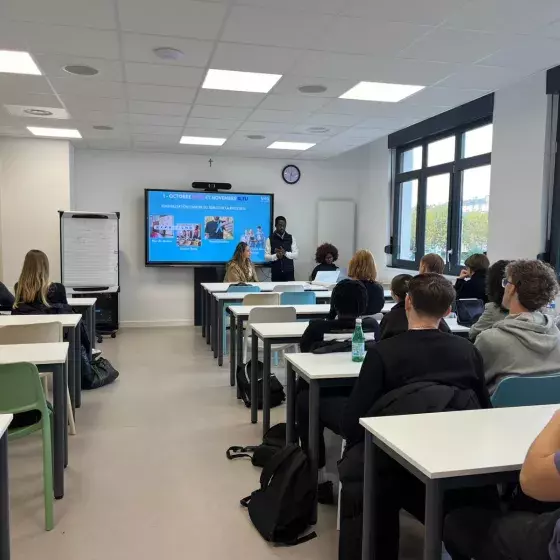
As you will have understood, e-learning above all enables learners and trainers to free themselves from the obligation to meet in the same place and at the same time so that knowledge can be passed on. The learning experience in distance learning is unique because the classes are virtual, the training modules are accessible online and the learning content is digitised. More concretely, an online training course, such as those offered at IPAG, will include synchronous courses during which the interaction with the trainer is effective in real time and asynchronous sessions where the learner consults his or her content media library autonomously. This is known as "mixed" online teaching (synchronous/asynchronous). Distance learning does not therefore mean an absence of exchanges, let's say rather that face-to-face sessions with the trainer, tutor or interactions between learners are digitised.
Why choose an e-learning course?
Compared to traditional initial training, i.e. training followed in person, distance learning has certain advantages which we have already begun to mention. First of all, e-learning offers incomparable flexibility in the management of training time by the learners themselves, who can acquire new skills where they want, when they want and at the pace that suits them, i.e. from an ATAWAD ("Any Time, Any Where, Any Device") perspective. Also, there are many more learning opportunities (virtual classes, gamification, mooc, social, mobile learning...) and more diverse teaching resources (videos, articles, podcasts, quizzes...).
online training course
The limits of e-learning
In addition to these conveniences, such as control over one's schedule, pace and training path, e-learning does have a few limitations. A minimum level of computer literacy and an Internet connection are two essential prerequisites for distance learning. Also, e-learning requires the learner to be much more involved in his own training than usual. Finally, the quality of distance learning provision is still uneven. In other words, you can train when you want, where you want but unfortunately sometimes, anyhow or with anyone. In fact, the online market attracts many organisations that lack real face-to-face experience before going digital. Some prices, sometimes very low, do not correspond to the value of a degree from a top school. It is therefore important to make sure you are well informed before choosing your online training. For its part, and unlike other organisations, a school like IPAG attaches as much importance to its online courses as it does to its face-to-face courses: each training plan is drawn up according to the same standards of excellence required for any other training programme, a pedagogical designer validates each module, and the quality of the LMS (Learning Management System) and the learning platform used enables learners to train in the best possible conditions. Finally, learner monitoring, tutoring and all the school's ancillary teaching activities are carried out remotely, in virtual classrooms or using interactive tools.
Our IPAG Online courses
IPAG's 100% digital offer includes four Master of Science degrees:
online training course