15 Oct

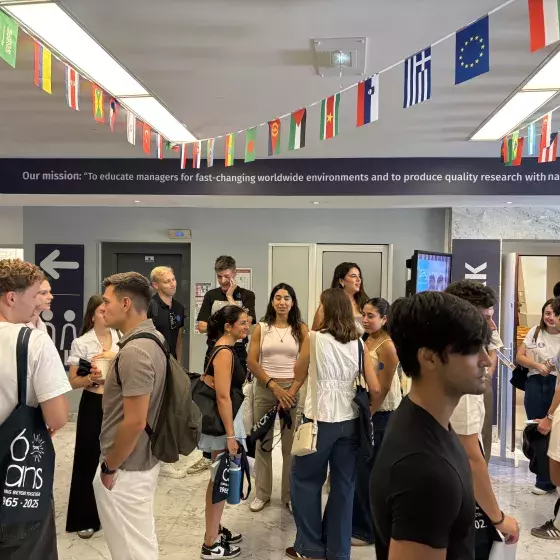
🇫🇷 Campus France Webinar - January and February Intake
Prepare your application to IPAG Business School and discover the key steps of the Études en France procedure with our practical tips.



Intake
Pace
Graduation diploma
 French
Presentation
This programme is aimed at Spanish-speaking female entrepreneurs living abroad who wish to develop a solid, visible and aligned business in a demanding international environment.
Its aim is to support ambitious women in structuring their strategy, asserting their leadership and transforming expatriation into a real lever for growth in a complex, uncertain and intercultural environment.
Trainer
Maria Isabel MONTIEL JAREÑO

Founder and Director of ExpaLatinas, she is a consultant and trainer specialising in the economic empowerment of Spanish-speaking women entrepreneurs and support for expatriate women. Through consulting and training, she works to promote economic independence, female leadership and better professional integration in multicultural contexts.
A lawyer by training, she practised law at the Campo Cabal law firm in Madrid and the Dorftmann law firm in Paris before moving on to management and coordination roles in international projects. She has been a project manager at Indra, a trainer for flight operators for AENA in Spain and GAP in Mexico, and a project coordinator in Central America and the Caribbean. Maria Isabel has also worked for the Colombian Embassy in Madrid as a legal advisor. She is a trainer and speaker at several leading academic institutions such as EFB Paris, ICP Paris, ISIT Paris, Sorbonne Paris and IPAG Paris.
Her expertise focuses on diversity and interculturality, female leadership, women's economic empowerment and international migration, with a committed approach aimed at raising awareness, increasing visibility and educating the public on these key issues.
Entrepreneurship and Intercultural Leadership
Duration: one day (7 hours)
By the end of the module, participants will be able to:
• Analyse their entrepreneurial environment in an international context.
• Understand the specificities of female entrepreneurship in an expatriate situation.
• Structure a strategic vision adapted to uncertainty.
• Strengthen their leadership position and legitimacy.
• Adapt their leadership, communication and decision-making skills in a multicultural context.
• Transform cultural differences into a performance lever.
• Female expatriate entrepreneurship: challenges, obstacles and opportunities.
• Leading and understanding in a FANI context (fragile, anxiety-inducing, non-linear and uncertain).
• Identity, legitimacy and strategic positioning internationally.
• Definition and mechanisms of culture.
• Ethnocentrism, stereotypes, cultural biases and gender biases.
• Communication and leadership styles according to cultural contexts.
Female leadership in an international context
• Authority, influence and credibility in a multicultural environment.
• Motivation, performance and management of professional relationships.
• Management of tensions and sensitive intercultural situations.
• Case studies based on real situations experienced by participants.
• Role-playing and intercultural scenarios.
• Development of an individual action plan: entrepreneurial attitude and leadership adapted to one's real context.
• Diagnosis of the entrepreneurial environment (host country/country of origin).
• Opportunities, regulatory, cultural and economic constraints.
• Risk management and decision-making in uncertain contexts.
• Strategic diagnosis of participants' projects.
• Collective perspective and experience sharing.
The trainer

He is a lecturer and researcher in law at IPAG Business School.
He holds a PhD in private law on the subject of ‘Corporate Social Responsibility, a comparative study of American and French law on listed companies’ from the University of Cergy-Pontoise, and publishes studies in various specialist journals, particularly in business law, family law, consumer law, liability law and contract law.
Dr Vincendeau also participates in various conferences in these fields and contributes to collective works.
Setting up and structuring your business in France: discovering a new legal environment
Duration: half day (3½ hours)
By the end of the module, participants will be able to:
• Understand the status of traders under French law, its legal implications and essential obligations.
• Identify the specific conditions applicable to foreigners wishing to carry out a commercial activity in France (trader's licence).
• Master the basics of contract law, which are essential for securing professional relationships.
• Choose a legal form suited to their entrepreneurial project (sole trader, SME, growth project).
Entrepreneurship in France: securing your project legally
The status of trader
• Definition and commercial acts.
• Legal obligations and responsibilities.
• Distinction between trader, craftsman and liberal profession.
• Access to economic activity.
• Foreign trader card: principle, conditions, procedure.
• Link with residence permits and points to note.
• Concept of a contract and conditions of validity.
• Obligations of the parties.
• Concrete examples: customers, suppliers, partners.
The partnership agreement and legal forms.
• Logic of the partnership agreement.
• Overview of the main forms (micro-enterprise, limited liability company, simplified joint stock company).
• Choosing according to the size and ambition of the project (SME/growth).
• Individual work on your own entrepreneurial project or a fictional project close to your reality.
• Identifying the legal status and form of operation best suited to your project.
• Identifying the essential steps and contracts to secure before launch.
La formatrice
Tessa RENAUDON

As a strategic consultant and coach, Tessa supports professionals and entrepreneurs in developing their businesses and optimising their organisations.
A former consultant at Google for more than five years, she has supported several hundred companies — microbusinesses, SMEs and large groups (Bureau Vallée, Caudalie, EDF, Air Caraïbes, etc.) — in developing their digital activities and digitising their processes.
She also worked as a key account manager at 360learning, a pioneer in collaborative training. In this role, she helped to roll out innovative training programmes within large organisations.
Now an entrepreneur, she uses her experience to help professionals who want to develop their digital visibility and build an effective communication strategy aligned with their objectives.
Digital strategy and professional networking
Duration: half day (3.5 hours)
By the end of the module, participants will be able to:
• Build a consistent professional digital presence on LinkedIn and Instagram.
• Master the codes of professional networking in the UK and develop a strategic network.
• Understand how LinkedIn and Instagram algorithms work to optimise your visibility.
• Create engaging content that highlights your skills and experience.
Digital technology at the service of professional integration.
• The importance of a digital presence in 2026.
• LinkedIn vs Instagram: when and how to use each platform.
The fundamentals of a professional LinkedIn profile.
• The 5 key sections of a profile that attracts recruiters.
• Optimising your headline, summary and experience.
• The importance of keywords for getting found.
• Each participant analyses their LinkedIn profile (or creates one).
• Identification of priority areas for improvement.
• Collective rewriting of an impactful professional headline.
• How to create an effective connection request.
• Best practices for contacting recruiters, executives, etc.
• The art of the thank-you message and follow-up.
Understanding LinkedIn and Instagram algorithms.
• How recommendation algorithms work.
• The types of content favoured by each platform.
• The best times to post and interact.
Creating content that showcases your career path.
• The three types of LinkedIn posts that generate engagement.
• How to turn your experience into storytelling.
• Highlighting your skills without falling into excessive self-promotion.
• Pair work: each participant writes a short post.
• Presentation of 2-3 examples to the group.
• Collective feedback and improvement.
Develop your strategic network.
• Identify key people to follow in your sector.
• Build a 30-day networking action plan.
• Groups and communities to join.
• Each participant leaves with 3 concrete actions to implement in the next 7 days.
Teaching methods
Teaching methods
Alternating between theoretical input, practical examples and collaborative workshops.
Digital resources
2- Supporting organizational change and evolving practices (afternoon)
Understand how AI is transforming professions, practices, and managerial approaches.
The impact of AI on organizations and public/private services.
Identify internal processes conducive to automation.
The manager's attitude towards innovation
Digital culture and gradual acculturation
Workshop 2
Reinventing a service with AI:
Work in small groups on a practical case study of improving a citizen service through AI. Case study: imagine a concrete use of
AI in a public/private service (communication, HR, etc.).
1- Explore available tools and identify best practices (morning)
Discover concrete and secure solutions to improve the performance and quality of public/private services.
Overview of accessible and relevant AI tools (ChatGPT, Copilot, Notion AI, Perplexity) for everyday use by teams.
Illustrated use cases
Limitations to be aware of
Best practices for responsible and ethical use.
Guided demonstrations.
Workshop 3.
Testing AI live:
Practical exercises tailored to the context of organizations: role-playing based on simple everyday scenarios: text creation, meeting summaries, internal memos, citizen messages, analysis, reporting.
2- Building your responsible AI roadmap (afternoon)
Provide participants with a method for integrating AI into their processes in a measured and ethical manner.
Define an AI strategy tailored to your management style.
Identify effectiveness indicators and conditions for success.
Integrate digital sobriety and ethics into implementation.
Anticipate training, communication, and support needs.
Steer an AI approach.
Workshop 4
Building my responsible AI strategy:
Formalizing an individual or team action plan. Each participant formalizes a concrete action plan to initiate the approach in their department.
Events
View allApplication
Contact